
Held Together
On Wholeness & Hazelnuts | Revised Common Lectionary, Year C, Proper 29

✢ Lection:
Colossians 1:11-20
“He himself is before all things, and in him all things hold together..For in him all the fullness of God was pleased to dwell, and through him God was pleased to reconcile to himself all things, whether on earth or in heaven, by making peace through the blood of his cross.”
—Colossians 1:17, 19-20.
✢ In Conversation With:
Julian of Norwich’s vision of the hazelnut from Revelations of Divine Love, Chapter 5.1
“And in this he showed me a little thing, the size of a hazelnut, lying in the palm of my hand. I looked at it with the eye of my understanding and asked, ‘What is this?’ And he said, ‘It is all that is made.’ I marveled that it might last, for I thought it could have fallen to nothing, it was so small. And I was answered, ‘It lasts and ever shall, because God loves it.’”
—Julian of Norwich, Revelations of Divine Love
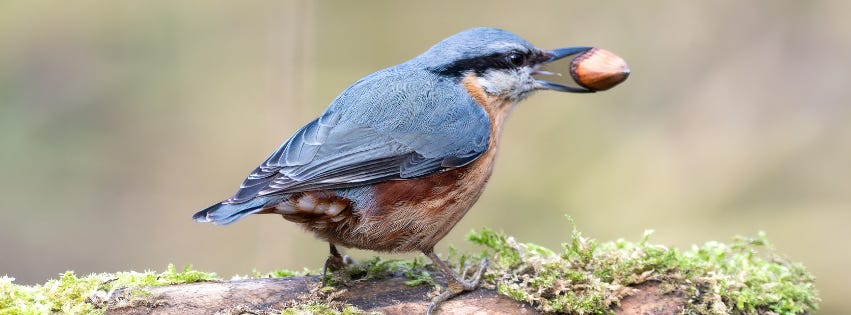
Julian of Norwich once wrote of her vision of the whole of God’s creation as something like a hazelnut resting in the palm of her hand. She marveled that, in its smallness and precarity, it continued to exist at all. God answered: “It lasts and ever shall, because God loves it.”
I think of that image at this hinge in the church year. This Sunday marks the end of the liturgical year, when Ordinary Time ends before Advent begins. The lectionary closes on the themes of Christ’s fullness, a reminder that all our fragments belong within a larger cosmic whole. We mark an ending by circling back to the beginning of it all: Christ at Creation, Christ at the center, Christ holding all things together.
When I first read Julian’s vision, I remember closing the book and cupping my own hands, trying to imagine the weight and feel of all things. To picture people, oceans, galaxies, things I know intimately, and things I will never lay eyes on all held together by God’s love. Julian’s hazelnut gave me a sense of the world’s coherence and my own. That small round nut did not hold itself together. It was held.
There are many days when that truth scatters again and it becomes difficult to feel how our lives cohere. This is why I return to this week’s lection, which offers a wider frame and a steady center.

Colossians is written by Paul to a young church learning how to live faithfully within a world full of competing stories about what holds everything together (Col 1:1–2).2 The community in Colossae lived in the first century in what is now southwestern Turkey. Their town sat along a busy trade route, but it was not a major city at the time this letter was written. Colossae had been overshadowed by its larger neighbors, Laodicea and Hierapolis, two thriving cities in the same valley, and it included people from several cultural and religious traditions.
Paul did not start this church himself. One of his coworkers, Epaphras, had shared the message of Christ there and later traveled to Paul to tell him how the community was doing (Col 1:7–8; 4:12–13). The Colossian Christians were trying to understand what it meant to follow Christ in a complicated environment.
They were surrounded by competing ideas about what gave meaning and spiritual strength in daily life. Some teachers influencing the community were encouraging practices drawn from local religion and strict rule-keeping, including dietary restrictions, festival observances, reliance on spiritual intermediaries, and harsh self-discipline, all of which made Christ seem smaller or less central (Col 2:8, 16–23).
Paul answers these pressures with a hymn. Colossians 1:15–20 is written in poetic and rhythmic lines that resemble other early Christian worship pieces.3 In this hymn, Paul names Christ as the image of the invisible God (Col 1:15), the one through whom all things came into being and for whom all things exist (Col 1:16). It asked this community to expand their vision outward to the cosmos, proclaiming that in Christ all things hold together (Col 1:17).
For a community uncertain about its place in the world, these words offered a reminder that their lives were held within a much larger story. The fullness of God dwelt in human form in Christ (Col 1:19), and through this Incarnation, God is reconciling all things in heaven and on earth (Col 1:20). Christ is the one through whom all things were made, and are now made whole again.
When Paul writes that God is reconciling all things to Godself through Christ, he uses the phrase “the all” or ta panta (Col 1:19–20). It is tempting to imagine ourselves at the center of that work, as if reconciliation begins with our decisions, our prayers, or our efforts to repair what has been harmed. Paul’s hymn resists that instinct. The hymn begins not with us but with Christ, who holds together the diverse pieces of creation, all that is seen and unseen.
If we pay attention to the language, we notice that it is not our world that God steps into in Christ. Everything we know, from black holes to beetles, belongs to God. We humans often place ourselves at the center of Christ’s reconciling work, yet Colossians reminds us that this healing is as wide as creation itself. All that is made is drawn into the gravity of reconciliation.
This passage emphasizes the peace Christ makes through the blood of his cross. I believe this is the peace of solidarity.4 Through Christ, God experiences the violence and fear of a broken world and refuses to return it. This refusal exposes violence as powerless to create life or goodness. It reveals that God’s way of healing does not rely on coercion but on presence, love, and mercy. In this way the cross ceases to be an instrument of Roman control and cruelty and becomes a sign of God’s steadfast willingness to stay with the world until it is healed.
Colossians resists the idea of an angry God demanding retribution for original sin and instead reveals a God who begins to heal the world by entering its brokenness and carrying its wounds into the very life of God.
This vision invites me to see my place within God’s renewing work with humility. The reconciliation Paul describes reaches way beyond the boundaries of my own concerns. It encompasses the land I live on, the air I breathe, the countless forms of life I will meet, and so much more than I will ever encounter of all that is.
Still, it is not beyond me. When I take steps toward healing at a personal scale or interpersonal scale, or when I take care of the creatures and places that sustain me, I am choosing to participate in the work that Christ has already begun. Sometimes that healing needs to begin inside me, in quiet decisions not to internalize or return the world’s unkindness, but to let Christ’s wholeness be the root from which I draw love, extend forgiveness and even draw boundaries.
Some of this work is as simple as what we can do today, like taking a quiet moment outside to appreciate this little hazelnut we live within. Some of this work asks for a more sustained commitment, like choosing one new practice for the church year ahead that contributes to my own healing or the healing of a community I call home.
Some of this work can become the shape of a whole life, a steady pattern of showing up for our neighbors so that our years bear witness to our healing God. Last month I helped preside at the memorial service of a beloved sage in our congregation, and story after story described a life shaped by small, steady acts of love. It was a reminder that what we choose to give today can become the graceful inheritance of a whole community.
Paul’s hymn is an invitation across the centuries to trust that Christ continues to hold all things together. When I read it, I like to imagine Julian in her fourteenth-century cell reading it too, seeing that little hazelnut of creation and hearing that God’s love sustains it. Each day gives us a chance to lean into that trust. We can choose intention over hurry, gratitude over resentment, and gentleness toward a world that shelters us in a much wider cosmos. In these small and daily ways, we let our lives rest in the One who holds all things together.
✢ Pocket Practice
A five-minute contemplative reflection.
Today I invite you to pause for a few minutes and let music carry this reflection a little further.
Find a comfortable spot where you can listen to the video below. Take a few centering breaths, sit back and enjoy an offering from one of my favorite music-makers, Heatherlyn.
She created a beautiful adaptation of the old hymn “Be Thou My Vision” by adding a chorus which is a commitment to truth, justice, and love. It reminds me all the ways I am called to participate in our being held together in God’s love.5
✢ Benediction
May the Christ who holds all things together
meet you in the smallness of today.
May you hold closer all that is broken
and so begin to help it mend.
May your work be presence and mercy,
and your life a steady witness to
our God who holds all things together.
Amen.
✢ Sources
Scripture quotations from the NRSVUE.
Brown, Raymond E. An Introduction to the New Testament. New Haven: Yale University Press, 1997.
Heatherlyn. “Be Thou My Vision.” YouTube video, 4:18. Posted February 19, 2020.
Johnson, Elizabeth A. Ask the Beasts: Darwin and the God of Love. London: Bloomsbury, 2014.
Johnson, Luke Timothy. The Writings of the New Testament. Minneapolis: Fortress Press, 2010.
Julian of Norwich. Revelations of Divine Love. Translated by Elizabeth Spearing. London: Penguin Classics, 1998.
Moltmann, Jürgen. The Crucified God. Minneapolis: Fortress Press, 1993.
Williams, Delores S. Sisters in the Wilderness: The Challenge of Womanist God-Talk. Maryknoll, NY: Orbis Books, 1993.
Julian of Norwich, Revelations of Divine Love, trans. Elizabeth Spearing (London: Penguin Classics, 1998), 13.
Many scholars observe differences in vocabulary and style between Colossians and Paul’s undisputed letters, while also noting that the letter identifies Paul as its author (Col 1:1) and was received by the early church as Pauline. For an even-handed discussion, see Luke Timothy Johnson, The Writings of the New Testament (Minneapolis: Fortress Press, 2010).
On the hymnic qualities of Colossians 1:15–20, see Raymond E. Brown, An Introduction to the New Testament (New Haven: Yale University Press, 1997), 612–614.
For interpretations of the cross that emphasize divine solidarity, see Jürgen Moltmann, The Crucified God (Minneapolis: Fortress Press, 1993); Delores S. Williams, Sisters in the Wilderness (Maryknoll, NY: Orbis Books, 1993); and Elizabeth A. Johnson, Ask the Beasts (London: Bloomsbury, 2014).
Heatherlyn, “Be Thou My Vision,” YouTube video, 4:18, posted February 19, 2020.
The hazelnut vision really resonated; it makes one ponder if it's universal principles or cosmic algorithms that truly hold everything togheter.