
As Close as Breath
On Presence & Pursuit | Revised Common Lectionary, Year A, Forth Sunday in Lent
✢ Lection:
Psalm 23
“Surely goodness and mercy shall follow me all the days of my life, and I shall dwell in the house of the LORD my whole life long.’”
–Psalm 23:6
✢ In Conversation With:
Marie Howe’s poem “Prayer.”1
Every day I want to speak with you. And every day something more important
calls for my attention—the drugstore, the beauty products, the luggage
I need to buy for the trip.
Even now I can hardly sit here
among the falling piles of paper and clothing, the garbage trucks outside
already screeching and banging.
The mystics say you are as close as my own breath.
Why do I flee from you?
My days and nights pour through me like complaints
and become a story I forgot to tell.
Help me. Even as I write these words I am planning
to rise from the chair as soon as I finish this sentence.
Before we turn to reflect on Psalm 23 this morning, I want to recount the Lenten journey through scripture I’ve been on these past several weeks. I have been tracing the path of Jesus through the wilderness toward the cross, weaving in some of the ancient wisdom of the psalms about the shape and movement of God in our world.
I began with the wilderness itself, and asked if nature was a place of nourishment for Jesus as it has been for me so consistently. Perhaps the wild things joined the angels in providing Jesus with sustenance to withstand the testing inherent in human life.
Then we turned to a reflection on Psalm 121, the psalm of ascent that offered us the image of God as our steady source of Help.
Last week, we went to the well with Jesus and that sassy Samaritan, where an honest conversation replete with doubts and challenge resulted in boundaries of belonging widened in surprising ways.
Today the invitation shifts slightly. Instead of asking where Jesus is leading us, the scriptures ask a quieter question: do we notice that God is already with us?

A contemplative teacher named James Finley once said that the central spiritual question of our lives may not be what we believe but whether we can learn to trust the holy presence already with us.2
Psalm 23 answers this question and, in doing so, became one of the most beloved prayers in all of scripture. People carry it in memory even when they have forgotten other passages. I’ve heard it quoted in hospitals, at funerals, in bedside prayers. Again and again these words return to us, often out of the old King James translation: “The Lord is my shepherd; I shall not want.”
In Hebrew the psalm begins with a small phrase: “Adonai ro’i” This is often translated, “The Lord is my shepherd.” The phrase is actually very simple in Hebrew. It contains no verb at all. It simply says, “The Holy One, my shepherd.” It points to an ongoing relationship of care.
Which is why we might hear it this way: The Holy One is shepherding me…right now, and in all the hard things I have come through, and into whatever landscape of life lies ahead.
This is a psalm about trust. It is not about escaping hardship. It is not a song about a blessed life where everything goes smoothly. It is a song about discovering that the Holy One is present with us, even in life’s darker valleys.
And that presence, the mystics say, is closer than we often realize. Still, trusting that presence is not always easy. Marie Howe writes: “The mystics say you are as close as my own breath.” Still, we forget our breath.
That line from Howe’s poem holds the very heart of my spiritual life. If God is truly that close, then the challenge of faith is not seeking God somewhere far away. The challenge is learning how to return my attention to the presence that has been with me all along.
Psalm 23 is a prayer about that kind of noticing, and Howe’s poem is a poem about how life distracts us from that kind of noticing. This is why I chose the Marie Howe poem as the conversation partner for this psalm. She writes:
Every day I want to speak with you. And every day
something more important
calls for my attention—the drugstore, the beauty
products, the luggage
I need to buy for the trip.
She gives us a picture of ordinary life. The errands. The distractions. The constant motion and minutiae of our days. Most of us do not intentionally turn away from God.
Instead, we become distracted. Our attention is pulled in many directions. The emails and texts. The news headlines. The schedules and responsibilities. Before we know it, the day has passed without a single moment of stillness or a single sentence of prayer.
We live with God within us, but we forget to acknowledge that.
The mystics say God is as close as our breath. Still, we forget to stop and breathe. Marie Howe captures that tension beautifully when she writes:
Help me. Even as I write these words I am planning
to rise from the chair as soon as I finish this sentence.
God's presence is available. But our attention wanders.
The Psalms themselves are an ancient prayer book. They were sung and prayed by the people of Israel across centuries in temples, homes, and communal gatherings (1 Chron. 16:7–9; Ps. 95:1–2). Some psalms are songs of celebration (Ps. 150). Some protest injustice (Ps. 10:1–2; Ps. 94:3–7). Some cry out in grief or anger (Ps. 13:1–2; Ps. 22:1). Psalm 23 belongs to a group often called psalms of trust (Ps. 23; Ps. 27:1–3; Ps. 46:1–3).
Traditionally Psalm 23 is associated with David. David first appears in scripture as a shepherd boy caring for his father’s flock (1 Sam. 16:11). He goes on to defeat the giant Goliath and become a military leader (1 Sam. 17:45–50). He eventually becomes the second king of Israel around 1000 BCE (2 Sam. 5:3–4). Jesus is described in the Gospels as coming from the “house of David” (Luke 1:32–33; Matt. 1:1). That’s this David.
The scriptural stories we are given about David portray a complicated person. He is courageous and deeply attentive to God (1 Sam. 17:37; Acts 13:22), yet also capable of serious failure (2 Sam. 11:2–4; 2 Sam. 12:7–9). He spends years in wilderness and danger before becoming king (1 Sam. 23:14–15), and the prayers associated with him reflect that kind of life.
The Psalms give voice to someone who brings every part of the human experience before God—trust and fear, gratitude and repentance alike (Ps. 32:1–5; Ps. 51:1–12; Ps. 62:5–8). Psalms connected to David’s name are traditionally linked to many moments of his life given to us in scripture as a shepherd, a fugitive fleeing King Saul, and later a king, expressing trust, lament, gratitude, and repentance before God (1 Sam. 19:1–2; 2 Sam. 22:1–3).
David spent his early life in the hills caring for sheep (1 Sam. 16:11). Which means the imagery of this psalm is not abstract. It comes out of lived experience. Psalm 23 begins in the fields with a shepherd and ends at a table prepared by a generous host (Ps. 23:1–5). In a way, it traces the arc of David’s own life, from shepherd in the hills to king in a palace (2 Sam. 5:4–5).
David would have known how a shepherd guides a flock through rough terrain, finds water in dry land, and watches carefully for danger in narrow ravines. So when the psalm begins, “Adonai is my shepherd,” it speaks of guidance that is patient, attentive, and protective (Ps. 23:1–3). The psalm imagines God as the one who accompanies the flock through every landscape life brings.
Notice something important: The psalm does not say life will always be grassy pastures. It says, “Even if I pass through death-dark ravines” (Ps. 23:4). The Hebrew phrase here is more often translated as “the valley of the shadow of death.” But the original language is actually a little broader than that. It refers to deep darkness. The kind of darkness that settles into narrow ravines where light barely reaches. For ancient shepherds in the Judean hills, those valleys were real places of danger where predators could hide, the path was narrow and footing was uncertain.
So this psalm is not imagining a life that avoids those places. It imagines a shepherd who walks the flock through them. Which means the promise of Psalm 23 is not that we will never enter dark valleys, but that we will not walk them alone (Ps. 23:4).
One of the most interesting features of Psalm 23 is the shift in language that happens halfway through the poem. Biblical scholars often point out that the psalm quietly changes pronouns at its center.
At the beginning, the psalm speaks about God:
“God makes me lie down in green pastures.”
“God leads me beside still waters.”
“God restores my inner person.”
“God guides me in right paths.”
(Ps. 23:2–3)
But when the psalm reaches the valley, the language changes. Suddenly the psalmist begins speaking directly to God:
“For you are with me.
Your rod and your staff reassure me.”
(Ps. 23:4)
The psalmist moves from describing God to addressing God.
When life becomes dangerous, faith becomes less theoretical and more personal. The language of belief becomes the language of relationship.
Many of us recognize that shift in our own lives.
In calm seasons, faith can remain a set of ideas, a bundle of beliefs we hold. But when we walk through deep shadow, the questions become more urgent.
Is anyone with me here?
Can I trust God’s presence?
Psalm 23 answers with quiet confidence: Yes. Presence is here. Even and especially here (Ps. 23:4).
Psalm 23 invites us into something that might be called the discipline of trust. A practice of returning our awareness to the presence that accompanies us.
Notice how the psalm describes God’s care: steady guidance to grassy pastures, to quiet waters, and to paths that lead toward justice and right relationship (Ps. 23:2–3). These images suggest restoration. At least in my own life, this guiding work of the Holy often feels like steady, gentle, quiet guidance of my life toward wholeness.
Even the rod and staff mentioned in the psalm are tools of shepherding. One protects the flock, the other guides it (Ps. 23:4). Together they symbolize a presence that keeps the flock moving toward safety. Psalm 23 is not promising that our path will not include dark valleys, but rather that we walk no valley alone (Ps. 23:4).
Perhaps the most surprising image in the psalm appears near the end: “You prepare a table for me even as my enemies watch” (Ps. 23:5).
Right in the middle of tension or danger, a table appears. A place of nourishment.
A place of hospitality. A place where life continues.
Psalm 23 ends with a table set in the presence of enemies and a cup that overflows. Long before communion tables appeared in churches, the psalm imagined a God who feeds us in the middle of life’s uncertainty. The circumstances may still be complicated. But there is still bread, still blessing, still community.
This psalm ends with a beautiful image: “Surely grace, or goodness, and mercy shall follow me all the days of my life” (Ps. 23:6).
The Hebrew word rāḏap̄, translated here as “follow,” is used elsewhere in scripture to describe someone chasing an enemy in battle (Exod. 15:9; Ps. 35:3; Lam. 3:43).
The psalm turns that image upside down. Instead of enemies chasing the psalmist, he imagines himself a sheep with goodness and mercy chasing after him. In other words, the psalm imagines goodness and mercy running after us, relentlessly.
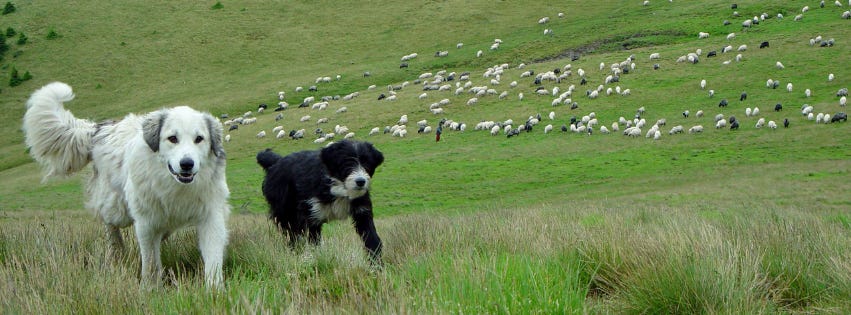
That is why some shepherds joke that the two most common names for sheepdogs are Grace and Mercy.
So when Psalm 23 says goodness and mercy pursue us all the days of our lives (Ps. 23:6), you can almost picture two loyal dogs running behind us on the deep-dark ravine paths of life, keeping us on those well-worn paths of goodness.
We often imagine ourselves searching for God, but the psalm suggests something different. Perhaps Goodness and Mercy have been seeking us out all along.
Howe reminds us that the mystics say God is as close as our breath. Psalm 23 invites us to live as though that were true. To pause. To breathe. To notice the nourishment and still waters we are being led to amidst our valleys.
This sort of noticing happens one small moment of attention at a time. Slowly, sometimes without realizing it, when we practice this noticing we begin to see what the psalmist saw. The house of the Holy is no distant place. It is right here within us, as close as our breath.
And when we begin to notice that goodness and mercy are already pursuing us, something else happens. We find ourselves sent back into the world with that same meddling goodness and mercy, working doggedly to turn harm toward healing, to guide fear toward compassion, and little by little to cultivate peace in the darkest valleys of this world.
✢ Pocket Practice
A Five-Minute Contemplative Exercise
Today’s practice invites you to listen prayerfully to the song “Ploughshare Prayer” by Spencer LaJoye.3 Spencer LaJoye’s music often lives at the intersection of tenderness and justice. Drawing on the ancient prophetic vision of swords beaten into ploughshares (Isa. 2:4; Mic. 4:3), this song wonders what might grow in the world if goodness and mercy truly did catch up with us.
Before pressing play, take one slow breath in and one slow breath out. Let your shoulders soften and your attention settle. Remember the invitation from Psalm 23 and from the mystics: the Holy One is as close as your breath.
As you listen, simply practice noticing what rises within you.
You might listen for one phrase that stays with you.
Or you might notice an image the music awakens in your imagination.
If it helps, hold these gentle questions in your heart while you listen:
Where in my life is goodness quietly pursuing me?
Where might mercy be asking to grow?
When the song ends, sit in silence for a few breaths. Let the music settle into you.
Carry one small noticing with you into the rest of your day.
✢ Benediction
May you breathe deeply of the life God gives you.
As you walk through the hills and valleys of the week ahead,
remember this:
Goodness and mercy are already running after you.
So go now,
and let goodness and mercy
catch up to the world through you.
Amen.
✢ Sources
Scripture quotations from the NRSVUE.
Finley, James. The Contemplative Heart. Notre Dame, IN: Sorin Books, 2010.
Howe, Marie. “Prayer.” On Being. Accessed March 14, 2026. https://onbeing.org/poetry/prayer/.
LaJoye, Spencer. “Ploughshare.” YouTube video. Accessed March 14, 2026.
.
Marie Howe, “Prayer,” On Being, accessed March 14, 2026, https://onbeing.org/poetry/prayer/.
James Finley, The Contemplative Heart (Notre Dame, IN: Sorin Books, 2010).
Spencer LaJoye, “Ploughshare,” YouTube video, accessed March 14, 2026,
.