
An Unknown God
On Presence in the Unfamiliar | Revised Common Lectionary, Year A, Sixth Sunday of Easter
✢ Lection:
Acts 17:22-29
“ For as I went through the city and looked carefully at the objects of your worship, I found among them an altar with the inscription, ‘To an unknown god.’”
– Acts 17:23
✢ In Conversation With:
“Home” by Warsan Shire.1

Sometimes I sit out on my back porch at night and look up at the stars. It is a place and posture that help me, and the troubles of my day, feel small enough to help me get some sleep. It reminds me of all the mysteries of this universe I get to call home for now. In some ways those back steps are an altar to an unknown God. Not because God is absent, but because God refuses to be contained by the container I know and live in.
Last week we reflected on a passage from just a few chapters earlier in the book of Acts, the story of Stephen being stoned to death outside Jerusalem (Acts 7:54–60). And standing there, watching it happen, approving of it, holding the coats of those throwing the stones, was a man named Saul (Acts 7:58; 8:1). In this week’s lection, we find that same man, now called Paul, standing in Athens, noticing altars and honoring mystery (Acts 17:22–23).
We got here by way of the road to Damascus, where Saul is stopped by a blinding encounter with the risen Jesus that leaves him unable to see and forces him to reckon with the harm he has done (Acts 9:3–9). He is healed, baptized, and begins again, no longer persecuting, but proclaiming the very presence he once tried to silence (Acts 9:17–22).
The story has not changed location only. It has changed the man.
Even how he arrives in Athens matters. He gets there because he has been displaced, moved along by conflict and resistance, carried into a place he did not choose. He arrives already learning how to encounter God in unfamiliar ground (Acts 17:10–15).

Athens was a city dense with gods, shrines, philosophies, and competing claims to truth. It would have been easy for him to dismiss it all, to name it as wrong, and to draw a sharp boundary between what is sacred and what is not.
But he does something more curious: he notices. He walks the city. He pays attention. He sees their devotion to the sacred, and then he finds it: an altar inscribed, “To an unknown god” (Acts 17:23). It is a small act of humility carved in stone, a recognition that even in a city full of competing ideas of God, there is still mystery. It is a quiet admission that whatever God is, God exceeds our understanding.
I have been holding that Athenian shrine alongside a line from an unlikely theologian, AC/DC manager Pete Holmes, who once said, “God is the name of the blanket we throw over the mystery to give it shape.” It is a funny line, and also a profound one, because it names something true about our impulse to define, to contain, and to make manageable what is ultimately uncontainable. We throw language over mystery, doctrine over wonder, and certainty over presence. Sometimes those blankets help us. They give us a place to begin, a place to feel safe, and a place to hold on. Sometimes the blankets we have thrown over the mystery become walls.
There are parts of Paul’s writings that I still struggle with. There are moments when his certainty feels too tight, when his theology has been used to draw lines that exclude rather than expand, and when his words have been taken up in ways that have done real harm. And yet, here, in this moment in Athens, I see something different. I see a Paul who is not arguing people into God but recognizing that God has already arrived ahead of him. I see a Paul who is paying attention, and that version of Paul is one I can at least be curious about.
Paul does not deny the mystery the Athenians have named. He honors it. He names a God who cannot be housed in temples or managed by human hands (Acts 17:24–25), a God who is not served by us as though God needed anything, a God in whom we live and move and have our being (Acts 17:28), and a God who is already there.
That matters for how I understand my faith, and it matters for how I understand every person I meet. If God is already present beyond the boundaries we draw, I have to continually ask myself where else I have failed to notice God’s presence.
Once I began to see God this way, as already present, already moving, and already near, it became harder to ignore where that presence might be showing up in ways the world has trained me not to see.
This is where Warsan Shire’s poem presses in with holy urgency:
“No one leaves home unless home is the mouth of a shark.”
Her words reject the distance that enables us to speak about refugees and displaced people as statistics or problems to solve. She pulls us close enough to feel the heat, the fear, and the impossible decisions.
People do not leave home lightly. They leave because staying becomes unlivable.
Because home itself turns against them. Because the land, the politics, the violence, the systems, the histories all converge into a single message whispered in the ear: leave.
Still, when they arrive somewhere new, they are so often treated not as bearers of God’s presence or even as neighbors, but as threats. They are detained, denied stable housing, and spoken about in language that strips dignity and belonging.
It is easier, perhaps, to keep them at a distance, to build categories that allow us to separate ourselves from them, and to assume that God is more present with us than with them.
Most of us have told ourselves the story that our home could never turn on us this way. Which, honestly, used to feel true to me. It does not anymore.
By show of hands, brave ones, how many of us have spent even a few minutes these past months trying to see if we have Canadian or Irish great-grandparents on the off chance we would qualify for dual citizenship?
The irony of those moments of genealogical curiosity is that I am an American because my own family carries a version of the story of displacement. Irish immigrants who arrived in this country during a time when signs were posted that read, “No Blacks, No Dogs, No Irish.”
My people were not welcomed as neighbors. My people were treated as problems, as threats, and as people who did not quite belong. That history has softened in the telling over time, as many immigrant stories do once assimilation becomes possible.
But it was not soft when it was lived. It was marked by exclusion, suspicion, and the long, slow work of proving one’s worth in a place that had already decided otherwise. Remembering that lineage complicates any easy distance I might try to place between myself and those seeking refuge now.
If God is not contained, if God is not far from any of us, and if in God we all live and move and have our being (Acts 17:27–28), then God is not waiting for people to cross borders or gain status or prove worth before becoming present.
God is already there. God is in the crowded boat, in the detention center just down the road from us, in the long line of paperwork and waiting, in the unfamiliar language, and in the quiet grief of everything that has been left behind. And perhaps, if we are willing to see it, God is very present in the courage it takes to begin again.
Which brings us back to Saul-turned-Paul. Because if anyone knows something about beginning again, it is him. The one who once stood at the edge of a killing field becomes the one who travels city to city proclaiming a version of the same gospel I proclaim to you. The one who once acted out of certainty learns how to stand in mystery. His life becomes its own testimony that transformation is always possible, that people are not fixed in their worst moment, and that even those complicit in harm can be drawn into a different way of being. That does not erase what happened to Stephen, but it does insist that the story does not end there.
There is a historical rhyme here that we would do well not to forget: displacement is rarely a choice. It has always been shaped by forces larger than any one person, including empire, war, economics, climate, policy, and fear. And still, again and again, those who are displaced are treated as the problem rather than the result of the problem.
Our faith asks something different of us. It asks us to recognize presence before judgment and to meet people not as categories, but as bearers of the same holy breath that animates us.
Paul makes the claim that we are all God-created (Acts 17:28–29). Which means we do not get to decide who belongs to God. We only get to decide whether we will recognize, or at least seek to recognize, God’s presence in one another.
So what does this mean for me this week? It might mean noticing where I have drawn our own altars to certainty and asking what mystery I have excluded. It might mean I need to do the hard work of examining the systems I participate in that treat some lives as disposable. It might mean listening more closely to the stories of those shaped by displacement, not to fix or solve, but to understand.
It certainly means continue to practice a different kind of seeing that the cultural norm, one that assumes God is already there, even and especially in the places we have been taught to overlook. So it is in that spirit that I pray for God to be my vision, to help us see the mystery of the holy and the presence of the sacred in all things.
✢ Pocket Practice
A five-minute contemplative practice.
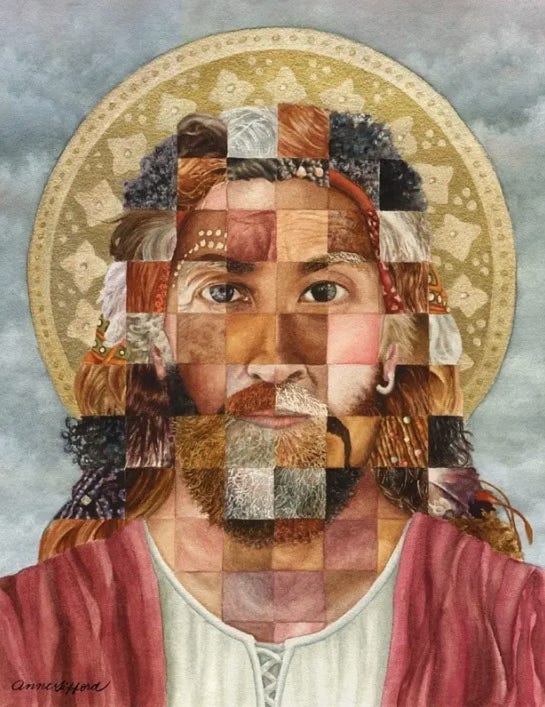
Today’s practice is inspired by “It’s All About Love” by Anne Gifford, whose mother, Priscilla, is part of my home congregation, Cairn Christian Church (Disciples of Christ).
Begin with a slow breath in, and a slow breath out.
Take a moment to look at the image. You may notice that the face of Jesus is formed from many different tones and textures of human skin and hair.
For the first minute, simply notice.
Notice color, contrast, and variation.
Let your eyes move gently across the image without trying to analyze it.
For the second minute, notice your instinct to categorize.
Where do you try to separate or define what you see?
Where do your eyes linger, and where do they move quickly past?
For the third minute, take in the whole.
What happens when you allow all the different pieces to belong to one body?
What does it mean to see Christ revealed through difference?
For the fourth minute, turn inward.
Where in your life have you been taught to separate, rank, or distance yourself from others?
Bring one of those places to mind. Ask quietly:
What might it mean that God is already present here too?
For the final minute, rest.
Let yourself be held by the possibility that the image of God is more expansive than you imagined.
As you close, carry this simple prayer:
May I learn to recognize the holy
in every face I meet.
Amen.
✢ Benediction
May you go in peace
into a world that is full of mystery,
held by a God beyond naming.
May you recognize the sacred
wherever you find yourself,
and trust that you are never far
from the Holy.
Amen.
✢ Sources
Scripture quotations from the NRSVUE.
Shire, Warsan Shire. “Home.” In Teaching My Mother How to Give Birth. London: Flipped Eye Publishing, 2011.
Warsan Shire, “Home,” in Teaching My Mother How to Give Birth (London: Flipped Eye Publishing, 2011).