
Like Lichen
On Stones and Stephen | Revised Common Lectionary, Year A, Fifth Sunday of Easter
✢ Lection:
Acts 7:55-60
“While they were stoning Stephen, he prayed, ‘Lord Jesus, receive my spirit.’
Then he knelt down and cried out in a loud voice, ‘Lord, do not hold this sin against them.’ When he had said this, he died.”
– Acts 7:59-60
✢ In Conversation With:
An original haibun.
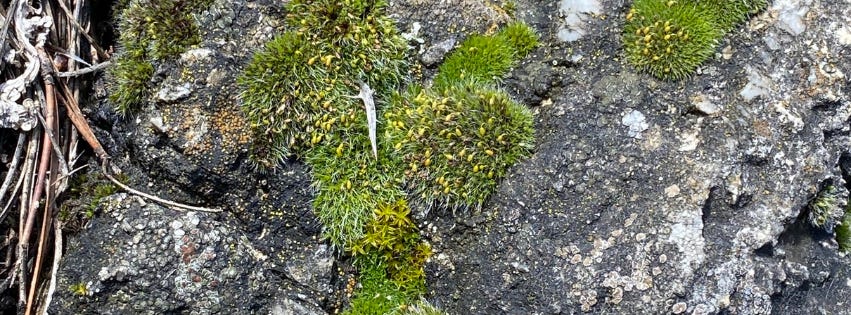
I spent part of this week at La Foret Conference and Retreat Center, gathering with UCC clergy from across greater Denver, sharing the challenges and joys of congregational life in this cultural moment. We explored what it might mean to cultivate connectedness between our beloved communities, like mycelium: threads of relationship carrying care and encouragement between us. Between those conversations and time walking La Foret’s labyrinth, while holding this week’s lection, this poem began to take shape.

I have been thinking about all the stones people still throw these days.
Hard handfuls of hate against race and gender and age and ability and class and sexuality and citizenship status, anything that lets me feel different from you.
Layers of fear compacted into something we can hold and hurl.
I like the way the earth holds stones. Lichens soften them. Rain and rivers wear them down. Roots slip quietly into their cracks. Even stones, given time, become soft soil.
I think about Stephen, on his knees, looking up as the crowd leans down for the nearest rock. Asking for mercy for those doing the throwing before the ground,
and God, receive him for good. It is one thing to imagine forgiveness after the wound has closed, after time has done its slow work of sanding down our sharp edges.
It is another to release compassion while the stones are still flying. Walking this labyrinth path, I asked again if the earth would teach me how to take in what is hard. How to do the slow and steady work of making room for life to begin again
out of hard things.
lichen on granite
roots threading through every crack
mercy before we’re dust
✢ Pocket Practice
A five-minute contemplative practice.
If you can, find a labyrinth near you this week. If not, choose a familiar path through the woods, a park, or even a quiet stretch of sidewalk.
Begin walking slowly. As you take your first steps, notice what you are carrying. Without judgment, name the “stones” in the pockets of your life. They may be fears, resentments, grief, or the weight of a relationship that feels broken.
Let your pace be unhurried. Feel your feet meet the ground. Notice the steadiness of the earth beneath you.
As you walk, imagine placing one stone down with each breath. You do not have to throw it. Just release your grip and allow the earth to begin its work.
Ask quietly:
What might it mean to entrust this hurt to God’s boundless compassion, rather than having to resolve it alone?
You are not being asked to excuse harm or remain in unsafe situations. You are just choosing a partner whose mercy is bigger than any of us can understand to help you hold it.
As you begin to walk again, notice what has shifted, even slightly. Not everything will feel lighter.
Carry this with you: the earth knows how to receive what is hard and, in time, make room for life to grow again.
Let your final steps be a simple prayer:
Teach us how to lay down our stones. Amen.
I love your poem, Nicole!
Thank you ❤️